Best Vehicle History Report Site: TrulyCar Reviewed
 Chris HansVehicle History ExpertAugust 27, 20268 min read
On this page
- Verdict: is this the best vehicle history report site?
- What's actually in the report
- Title and brand checks
- Damage events with auction photos
- Odometer chronology with rollback detection
- Sales and usage timeline
- Open recalls and the factory maintenance schedule
- Warranty terms and market values
- Real-world performance across five VINs
- Pricing and what it really costs per car
- Where free vehicle history report tools fit
- How it compares to the big names
- Final verdict: the best vehicle history report site for most buyers
- FAQ
- Is there a truly free vehicle history report?
- How much should a vehicle history report cost?
- Does the report show every accident?
- Can I look up a car by license plate instead of VIN?
- Do dealers accept a TrulyCar report?
- What if the report and the seller's story disagree?
Verdict up front: for the average person buying one or two used cars a year, TrulyCar is the best vehicle history report site because it puts title brands, damage records with auction photos, and a full odometer chronology behind a single $16.99 payment instead of a subscription. I'd score it 4.5 out of 5, with the missing half point going to the same gap every history service has, which is that no report can list repairs that were never written down anywhere.
This review is based on running real VINs through the product: a 2016 Honda Accord from a franchise dealer lot, a 2019 Ram 1500 listed by a private seller in Texas, a 2014 BMW 328i with suspiciously cheap pricing, and a handful of others I pulled from Facebook Marketplace listings. Below is what showed up, what didn't, what it costs, and who should skip it.
- Verdict: is this the best vehicle history report site?
- What's actually in the report
- Real-world performance across five VINs
- Pricing and what it really costs per car
- Where free vehicle history report tools fit
- How it compares to the big names
- Final verdict: the best vehicle history report site for most buyers
- FAQ
Verdict: is this the best vehicle history report site?
Short answer: yes, if you're paying out of your own pocket and shopping a small number of cars. It's less obviously the right pick if you're a high-volume dealer who needs a wholesale feed or a report brand that customers recognize from TV ads.
| Category | Result |
|---|---|
| Overall rating | 4.5 / 5 |
| Price | $16.99 per report, $29.99 for 3, $44.99 for 5. No subscription. |
| Best for | Private-party buyers, first-time buyers, small independent dealers |
| Strongest feature | Auction photo archives attached to damage events |
| Weakest point | Service history depends on shops reporting, same as every provider |
| Free tools | VIN decoder and US license plate lookup, no account needed |
What's actually in the report
There's one product, called the Complete Vehicle History Report. No tiers, no upsell at checkout for the "good" version. Here's what each section gave me.
Title and brand checks
This is the part that decides whether you walk away. The report pulls title records including NMVTIS data and flags brands like salvage, junk, flood, rebuilt, and insurance total loss. It also shows the state-by-state title path, which matters more than most buyers realize. A car that picked up a salvage brand in Florida, then got a clean-looking title in another state six weeks later, is telling you something. If that pattern is new to you, read how title washing works and how to spot a washed title before you shop.
Damage events with auction photos
This is the feature I'd pay for on its own. When a vehicle passes through a salvage or insurance auction, photos are usually taken of the damage. TrulyCar surfaces archived auction images alongside the damage record when they exist. On the 2014 BMW, I got seven photos showing right-front collision damage, a deployed passenger airbag, and a bent lower control arm. The seller had described it as "minor cosmetic." A line of text saying "damage reported" is easy to argue with. A photo of a crumpled strut tower is not.
Odometer chronology with rollback detection
Every reported mileage reading gets stacked in date order, so you can see the curve. Normal cars go up roughly 10,000 to 14,000 miles a year. The Accord read 41,208 in 2019, 58,940 in 2021, and 71,455 at the last inspection, which is a believable line. Rollback flags fire when a later reading comes in under an earlier one, and the report also catches the "stuck" pattern where a car reports nearly identical mileage across two or three years of registrations.
Sales and usage timeline
Registration events, ownership changes, and use type (personal, lease, rental, fleet, taxi) land on one timeline. A 2019 Ram that spent 26 months in a commercial fleet before hitting a retail lot is not the same truck as an owner-driven one with the same mileage, and the price should reflect that.
Open recalls and the factory maintenance schedule
Open recall campaigns come from NHTSA data and show up as unrepaired items you can hand to a dealer for free warranty work. The report also includes the manufacturer's published maintenance schedule for that vehicle, which is genuinely useful for budgeting. Seeing that the BMW's next service interval includes spark plugs and a brake fluid flush changes what you offer.
Warranty terms and market values
You get factory warranty terms (bumper to bumper, powertrain, corrosion, and any hybrid or EV battery coverage) with the in-service date, so you can work out what's left. Market values are broken out by condition, which gives you a number to point at during negotiation instead of a feeling.
Real-world performance across five VINs
Reports came back in under a minute each time. Delivery is on-screen plus a PDF you can save, which matters because you'll want to forward it to a mechanic or show it to the seller on your phone.
The 2016 Accord came back boring, which is the goal. Three owners, one minor damage report from a 2020 rear-end hit with no airbag deployment, clean title throughout, no open recalls. That's a car worth going to see.
The 2019 Ram 1500 showed the fleet history I mentioned plus an odometer gap: 61,000 miles reported in March, then nothing for 19 months until it surfaced at 118,400. Not proof of anything shady, but it told me to expect a hard-worked truck and to inspect the frame and rear suspension closely.
The 2014 BMW is the one that saved real money. Total loss record, rebuilt title, auction photos. The seller was asking about $9,400 against a clean-title retail range of roughly $11,000 to $12,500. That gap looked like a bargain until the photos explained it.
Two other VINs, a 2017 Subaru Outback and a 2012 Toyota Camry, came back thin on service records. The Camry had exactly two service entries in twelve years. That's not a product failure so much as a reality of the industry: independent shops and driveway oil changes rarely report anything to any national database. If a seller's binder of receipts contradicts a sparse service section, believe the receipts. If a seller has no records at all, the sparse report doesn't rescue them.
Pricing and what it really costs per car
| Package | Price | Cost per report |
|---|---|---|
| Single report | $16.99 | $16.99 |
| 3-pack | $29.99 | About $10.00 |
| 5-pack | $44.99 | About $9.00 |
No recurring charge, no trial that quietly converts, no card on file waiting to bill you in 30 days. You buy credits, you use them when you find a car worth checking.
Context on the market: single reports from the household-name providers commonly land in the mid-forties, and multi-report bundles from those services are usually sold on the assumption you're checking a lot of cars. Against that, five TrulyCar reports for $44.99 is the arithmetic that most buyers care about. It also changes behavior. When a report costs the better part of fifty dollars, you ration them and end up checking only your favorite car. At nine or ten dollars each you check all five, and the whole point of a history report is catching the one you would otherwise have driven three hours to see.
If you want to try the tools before spending anything, the free VIN decoder and plate lookup are on the homepage, and a full vehicle history report from TrulyCar covers the title, damage, odometer, recall, and value records described above.
Where free vehicle history report tools fit
Let's be honest about the phrase "free vehicle history report." Genuinely free resources exist, but none of them give you the full picture:
- Free VIN decoding. Confirms year, make, model, engine, trim, and plant. Good for catching a listing that claims a V6 when the VIN says four-cylinder.
- Free recall lookup. NHTSA's recall tool tells you about open safety campaigns at no cost.
- Free plate lookup. Useful when a listing shows a plate in the photos but hides the VIN.
- NMVTIS background. The Department of Justice explains the title system at vehiclehistory.bja.ojp.gov, including which providers are approved to sell that data.
What free tools won't show you is the damage timeline, the mileage chronology, the auction photos, or the ownership pattern. Any site promising all of that for nothing is either collecting your email to sell you something later or showing you a decoded VIN dressed up to look like a history report. Sites that ask for a credit card to "unlock your free report" are running a trial that bills monthly. Read the fine print before you type your number in.
How it compares to the big names
CARFAX and AutoCheck have been in this business a long time and have deep dealer relationships. Plenty of franchise dealers hand you a CARFAX with the car, and if the dealer is paying, take it and read it. Brand recognition has real value when you go to resell, too: some buyers only know one name.
Where TrulyCar wins is cost per check and the auction imagery. Copart and IAAI, the two large salvage auction operators, list wrecked and total-loss vehicles publicly, and photos from that pipeline are what turn a vague damage line into a decision you can defend. Where the big names win is name recognition and, in some cases, longer-running dealer service data on specific vehicles.
My practical advice: if a seller already has a report from another provider, read it, then run your own on the same VIN. Different providers get different records because reporting is voluntary and inconsistent. Two reports for a combined price under $20 is cheap insurance on a $15,000 purchase. For a side-by-side breakdown, see TrulyCar vs CARFAX.
Final verdict: the best vehicle history report site for most buyers
4.5 out of 5. For private-party shopping, first-time buyers, and small lots buying a few cars a month, TrulyCar is the best vehicle history report site on price-to-information alone, and the auction photos push it past services that only give you text. The 5-pack at $44.99 is the version I'd buy, because checking five candidates beats checking one.
Two caveats worth stating plainly. First, no history report replaces a pre-purchase inspection; spend the $120 to $200 on a mechanic before you hand over money. Second, a thin report is not the same as a clean car. It means nothing was reported, and plenty of unreported bodywork rolls down the highway every day. Use the report to eliminate cars quickly and cheaply, then use your eyes, a scan tool, and a lift on the survivors.
FAQ
Is there a truly free vehicle history report?
Not a full one. You can decode a VIN, run a plate lookup, and check open recalls through NHTSA without paying. Title brands, damage events, auction photos, and odometer chronology come from paid record sources, so any site offering all of that for free is usually collecting your data or setting up a billed trial.
How much should a vehicle history report cost?
Single reports from the best-known providers typically run in the mid-forties. TrulyCar charges $16.99 for one, $29.99 for three, and $44.99 for five, with no recurring billing. The right question is cost per car checked, since you'll want reports on several candidates before you buy.
Does the report show every accident?
No provider can. Reports show accidents that were reported to police, insurers, auctions, or state agencies. A fender bender repaired with cash at a local body shop leaves no trail. Treat a clean report as a green light for further inspection, not as proof of an undamaged car.
Can I look up a car by license plate instead of VIN?
Yes. The homepage plate lookup covers US plates and returns the VIN, which you can then run a full report on. That's handy when a listing photo shows the plate but the seller won't post the VIN.
Do dealers accept a TrulyCar report?
You're the one using it, so acceptance isn't really the issue. Bring the printed or PDF report to the negotiation and point at specific records: a total loss entry, a mileage gap, an open recall. Sellers respond to documentation, whatever the logo at the top says.
What if the report and the seller's story disagree?
Ask about it directly and watch the reaction. Records get mismatched occasionally, and an honest seller with receipts can usually clear it up in two minutes. Vagueness, deflection, or sudden pressure to close is your answer.
Chris Hans
Vehicle History Expert
Chris Hans writes TrulyCar's practical guides for used-car buyers, built on the same NMVTIS title data and NHTSA records that power our reports.
Buying a used car? Check its history first.
Run a free VIN checkKeep reading
How to Check if Car Was in an Accident (Police + Insurance)
How to check if car was in an accident using police crash reports, insurance total loss records, NMVTIS title data, and salvage auction photo archives.
Sep 13, 20269 min read
How to Check if Car Was in an Accident: 9 Steps
How to check if car was in an accident: pull title and total loss records, request the police crash report, read auction photos, and verify the repairs.
Sep 8, 20269 min read
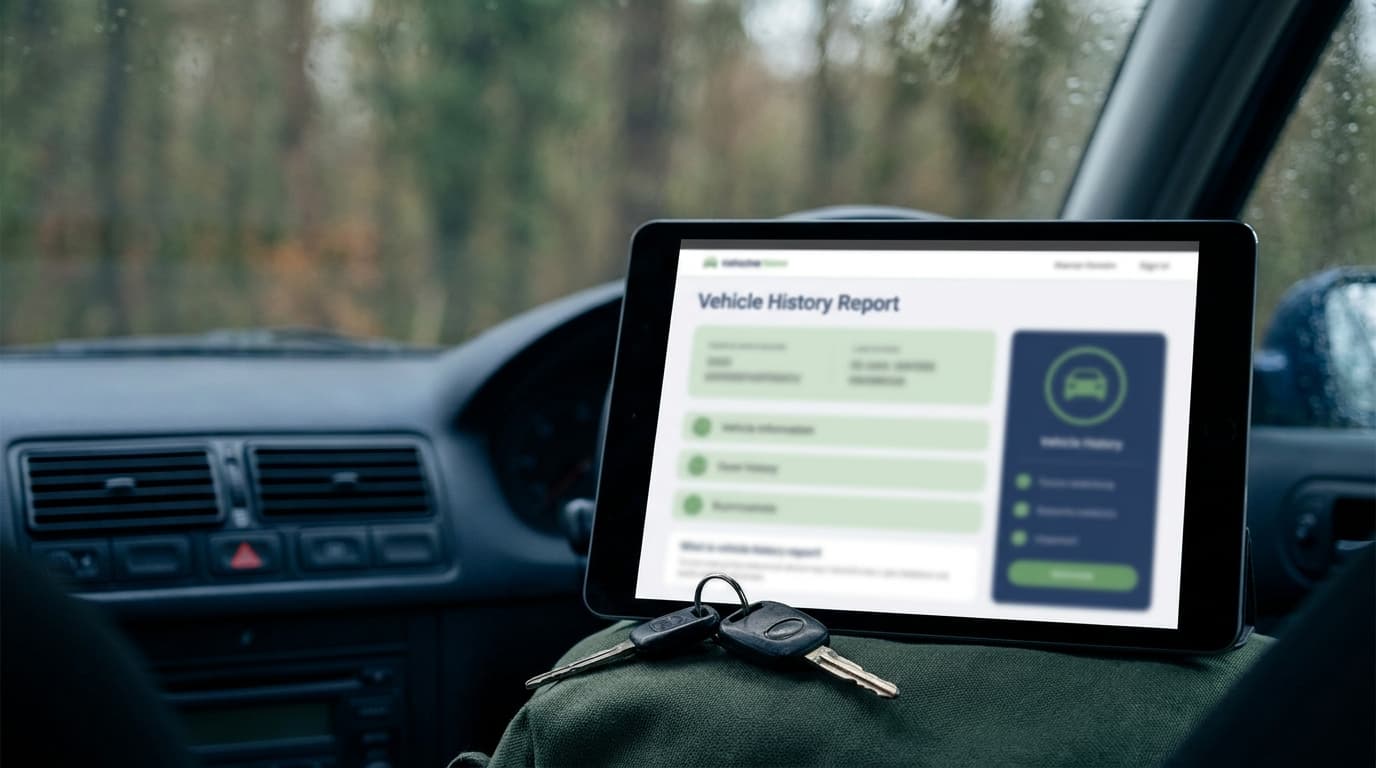
TrulyCar vs CARFAX: A CARFAX Alternative at $16.99
TrulyCar vs CARFAX: how a $16.99 CARFAX alternative compares on price, title data, damage photos, recalls and market values before you buy.
Sep 3, 20267 min read