How to Buy a Used Electric Vehicle: 9-Step Guide
 Chris HansVehicle History ExpertOctober 12, 20269 min read
On this page
- At a glance
- What you need before you shop for a used electric vehicle
- 9 steps to buy a used electric vehicle
- Reading battery state of health yourself
- Nissan Leaf
- Tesla
- Chevy Bolt, Ford, Hyundai, Kia
- Charging hardware and real running costs
- Warranty, title and incentive paperwork
- Troubleshooting common problems
- The seller won't let you run an OBD scan
- Displayed range looks fine but the car runs out early
- The history report shows an auction listing but no title brand
- You can't pair the manufacturer app after purchase
- Charging stops partway through at home
- FAQ
- What mileage is too high for a used electric vehicle?
- How much does a replacement EV battery actually cost?
- Does a vehicle history report tell me anything useful about an EV?
- Should I buy a used EV from a private seller or a dealer?
- Is battery degradation covered by the factory warranty?
- How many VINs should I check before I buy?
Buying a used electric vehicle comes down to three things the window sticker won't tell you: how much battery capacity is left, how much of the 8-year battery warranty transfers to you, and whether the car has open recalls or a damaged title. Get those right and a four-year-old EV can be one of the better values on a used lot. Get them wrong and you inherit a $9,000 pack replacement.
The mechanical side is actually easier than with a gas car. No timing chain, no head gasket, no transmission to rebuild. The homework shifts to electrons, software, and paperwork. Here's the order I'd work through it.
At a glance
What to check | Why it matters | Where you find it |
|---|---|---|
Battery state of health | A pack at 82% of original capacity turns a 250-mile EPA rating into about 205 miles | In-car service screen, OBD app (LeafSpy, Scan My Tesla), dealer diagnostic printout |
Battery warranty remaining | Federal minimum is 8 years/100,000 miles; California rules push some cars to 10 years/150,000 | Build date plus odometer; manufacturer owner portal; vehicle history report |
Open recalls | Battery recalls on the 2017-2022 Chevy Bolt and 2019-2020 Hyundai Kona Electric involved pack replacements | nhtsa.gov/recalls by VIN |
Title brands | Flood and salvage EVs are often written off because of the pack, not the body | NMVTIS-sourced title records in a history report |
DC fast charging hours | Heavy fast charging accelerates degradation on air-cooled packs | Charge history in the manufacturer app, previous owner, service records |
Included charging equipment | A replacement Level 2 charger and install runs $500 to $2,000 | Trunk inspection, ad listing, seller |
What you need before you shop for a used electric vehicle
Gather this before you start test driving. It takes an evening.
The VIN of every car you're considering. Not the stock number. The full 17 characters, from the dash plate or the driver's door jamb sticker.
A phone with the manufacturer's app installed. FordPass, Tesla, MyChevrolet, Kia Connect, MyHyundai. You can't always pair it before purchase, but the app's VIN lookup often shows warranty dates.
An OBD2 dongle if you're shopping Nissan Leaf, Chevy Bolt, or BMW i3. A $25 Bluetooth adapter plus a $20 app reads pack data the dash won't show.
Your home charging answer. Do you have a 240V outlet in the garage, or a plan to get one? Quote the electrician first. A panel upgrade can cost more than the price gap between two cars you're comparing.
A history report budget. TrulyCar runs $16.99 for a single report, or $29.99 for a 3-pack if you're cross-shopping several cars at once. The big legacy brands generally sit near the mid-$40s for one standalone report, so the multi-car math matters when you're checking five VINs in a weekend.
9 steps to buy a used electric vehicle
Decode the VIN for free and confirm the trim. EV trims change range dramatically. A 2019 Tesla Model 3 Standard Range Plus and a Long Range AWD look nearly identical in photos but differ by roughly 100 miles of rated range. Run the VIN through a free decoder (TrulyCar's homepage does it, and so does NHTSA's own tool) to confirm battery size, drive configuration, and plant. If the listing says "Long Range" and the decode says otherwise, walk.
Pull the full history before you drive out there. You want title brands, odometer chronology, damage events with auction photos, and open recalls in one place. A vehicle history report from TrulyCar covers those records, pulling from NMVTIS title data and NHTSA recall and specification data. Pay attention to out-of-state title transfers that happen shortly after a hurricane, and to any auction photos showing waterlines or deployed airbags. EVs that sit in salt water get totaled fast, and a cleaned up one can look perfect. Our guide on spotting a flood damaged car from out of state goes deeper on the tells.
Check open recalls by VIN at NHTSA. Go to nhtsa.gov/recalls, enter the 17-character VIN, and read every result. For the Chevy Bolt, you want proof the replacement pack was installed, not just the software limiter. Ask the seller for the dealer repair order with the date and the new pack's part number. "The dealer said it's fine" isn't proof.
Verify battery warranty dates, not model year. The clock starts at the original in-service date, which can be months after the build date. A car titled in March 2018 with an 8-year/100,000-mile pack warranty has coverage until March 2026 or 100,000 miles, whichever comes first. If the car was originally sold in California or another state following CARB rules, some models carry 10 years/150,000 miles on the pack. Call the brand's customer care line with the VIN and ask them to read the in-service date to you.
Measure state of health on the car itself. Details by brand are in the next section. Do this before you negotiate, because a pack at 88% versus 95% is worth real money.
Drive it with the heat on. Cabin heat is the single biggest range killer on EVs without a heat pump (most pre-2021 Leafs, early Bolts, base Model 3s). Set climate to 72, turn on the defroster, and watch the projected range drop. You want to know that number in January, not discover it. Also check that the car accepts a charge: plug into any Level 2 station during the drive and confirm the charge screen shows kW flowing, not an error.
Run one DC fast charge session. Find a CCS or NACS station, start a session, and watch the peak rate. A healthy 2020 Bolt should climb past 50 kW at a low state of charge. If a car that should pull 100 kW tops out at 30 kW with a warm pack and 20% charge, something is throttled. Many sellers will meet you at a charger if you ask. If one refuses outright, that tells you something.
Get a pre-purchase inspection from someone who works on EVs. They're checking different things: coolant loops for the battery and inverter, 12V battery condition (EVs eat these), brake caliper seizure from regen-only driving, suspension bushings, tire wear from instant torque. Tires on a 4,800-pound EV wear faster than you expect, and a set for a Mach-E or Model Y runs $900 to $1,400 installed. Budget that into your offer.
Close the paperwork clean. Confirm there's no lien on the title, get the charging cable and any adapters in writing, and have the seller remove the car from their manufacturer account before you take delivery. On a Tesla, that means the previous owner removing the vehicle from their app; otherwise you can't pair it. Our walkthrough on checking for a lien before you buy covers the private-sale version of this.

Reading battery state of health yourself
Every manufacturer handles this differently, and some hide it entirely. The reliable methods:
Nissan Leaf
Look to the right of the state-of-charge gauge on the dash. Twelve small bars means the pack is above roughly 85% capacity. Eleven bars means it has dropped below that threshold. Nine or fewer bars on a 24 kWh 2013-2015 Leaf is a city-only car. For the real number, plug in an OBD2 adapter and run LeafSpy Pro, which reports SOH as a percentage along with cell voltage spread. A spread over 30 mV on a warm pack suggests weak cells.
Tesla
There's no official SOH readout on the touchscreen. Charge the car to 100% and compare the displayed rated range to the original EPA figure for that trim. A 2019 Model 3 Long Range showed 310 miles new; if it shows 272 at full charge, you're looking at roughly 12% loss, which is normal for 70,000 miles. The Scan My Tesla app over OBD gives nominal full pack energy in kWh, which is more precise. Also check the "Software" screen for the current version and the odometer.
Chevy Bolt, Ford, Hyundai, Kia
Dealer diagnostic tools report pack capacity directly. Ask the selling dealer to print the battery capacity report. For Hyundai and Kia, a hidden diagnostic menu on the instrument cluster shows SOH on many model years; a technician can pull it in two minutes. Ford owners can review charge history in FordPass, which shows how often the car saw DC fast charging.
Rough benchmark: most modern liquid-cooled packs lose 8% to 12% in the first 100,000 miles, then flatten out. Air-cooled packs (the 2011-2017 Leaf especially) in hot climates like Phoenix or Las Vegas degrade much faster. A Leaf from Arizona and a Leaf from Oregon with identical mileage are not the same car.
Charging hardware and real running costs
Check which connector the car uses. Pre-2025 non-Tesla EVs mostly use CCS1. Older Leafs use CHAdeMO, and the CHAdeMO network is shrinking. Teslas use NACS, and many newer non-Tesla models now ship with NACS or an adapter. Ask whether the adapters are included, because a factory CCS-to-NACS adapter is a $200-plus item that sellers often keep.
On cost, do the arithmetic with your actual utility rate. At $0.16 per kWh and 3.5 miles per kWh, you're at about 4.6 cents per mile. A 28 mpg gas car at $3.40 a gallon is about 12 cents per mile. Over 12,000 miles a year that's roughly $890 saved. Public DC fast charging at $0.48 per kWh erases most of that, so an EV makes the most sense if you can charge at home. The EPA's fueleconomy.gov has per-model kWh/100 miles figures to plug into your own numbers.
Warranty, title and incentive paperwork
Three documents are worth chasing before money moves:
The original in-service date. Drives both the battery warranty and any remaining bumper-to-bumper coverage.
Recall completion records. Especially for battery campaigns. A repair order beats a verbal assurance.
A clean, lien-free title in the seller's name. If the name on the title doesn't match the person selling, stop. That's also a situation where a careful accident and damage check is worth the time.
On incentives: the federal used clean vehicle credit of up to $4,000 ended for vehicles acquired after September 30, 2025. State and utility programs still exist in many places, including rebates for home charger installation. Check your state energy office and your electric utility's website directly rather than trusting a dealer's claim about what you'll qualify for.
Troubleshooting common problems
The seller won't let you run an OBD scan
Some dealers have a blanket policy against buyers plugging in anything. Counter with a condition: you'll buy subject to a battery capacity report from their own service department, in writing, before the deal is final. If they won't produce one on a car they're asking $22,000 for, there's another car.
Displayed range looks fine but the car runs out early
The guess-o-meter predicts range from recent driving efficiency. If the last driver did 40 mph on flat roads, the estimate will be optimistic for your 75 mph commute. Judge by the kWh in the pack and your own Wh/mi consumption, not by the headline number.
The history report shows an auction listing but no title brand
Plenty of EVs go through Copart or IAAI as light-damage or theft-recovery units and come out with clean titles in some states. Look at the auction photos in the report. If the front clip is apart or there's water staining on the carpet, price it as a rebuilt car regardless of what the title says. More on that in our guide to finding auction photos by VIN.
You can't pair the manufacturer app after purchase
The prior owner usually still has the car on their account. Call the brand's customer support with the VIN, the title, and the bill of sale. Most will force-remove the old account within a few business days.
Charging stops partway through at home
Nine times out of ten this is the outlet or the mobile connector, not the car. Try a different circuit and a public Level 2 station before assuming the onboard charger failed. Onboard charger replacements are a real repair, but they're rarer than bad 14-50 receptacles.
FAQ
What mileage is too high for a used electric vehicle?
Mileage matters less than pack condition, climate, and charging habits. I'd take a 90,000-mile liquid-cooled EV from Seattle with 92% state of health over a 45,000-mile air-cooled one from Texas with nine capacity bars. Check the battery, then look at the odometer.
How much does a replacement EV battery actually cost?
Out of warranty, quotes commonly land between $6,000 and $18,000 depending on pack size and brand, parts and labor included. Used and remanufactured packs cost less on popular models like the Leaf. That spread is exactly why warranty dates are the first thing to verify.
Does a vehicle history report tell me anything useful about an EV?
Yes, though not battery health. It covers title brands, reported damage with auction photo archives, odometer chronology with rollback detection, the ownership and usage timeline, open recalls, and factory warranty terms. You still need a capacity test on top of it.
Should I buy a used EV from a private seller or a dealer?
Private sellers are usually cheaper and often more honest about charging habits, since they lived with the car. Dealers can run factory diagnostics and handle title work. If you buy privately, confirm the title is clear and in the seller's name, and handle payment at the seller's bank.
Is battery degradation covered by the factory warranty?
Partially. Most EV battery warranties cover capacity loss below a stated threshold, commonly 70%, within 8 years/100,000 miles. Normal degradation above that threshold is not a warranty claim. Read the specific language in your model's warranty booklet, since the threshold varies.
How many VINs should I check before I buy?
However many cars you're seriously considering. Most buyers test drive three to six before committing, which is why we sell reports in packs (3 for $29.99, 5 for $44.99, 10 for $79.00) rather than by subscription. Checking one VIN and skipping the rest is how people end up comparing a clean car to a flood car without knowing it.
Chris Hans
Vehicle History Expert
Chris Hans writes TrulyCar's practical guides for used-car buyers, built on the same NMVTIS title data and NHTSA records that power our reports.
Buying a used car? Check its history first.
Run a free VIN checkKeep reading
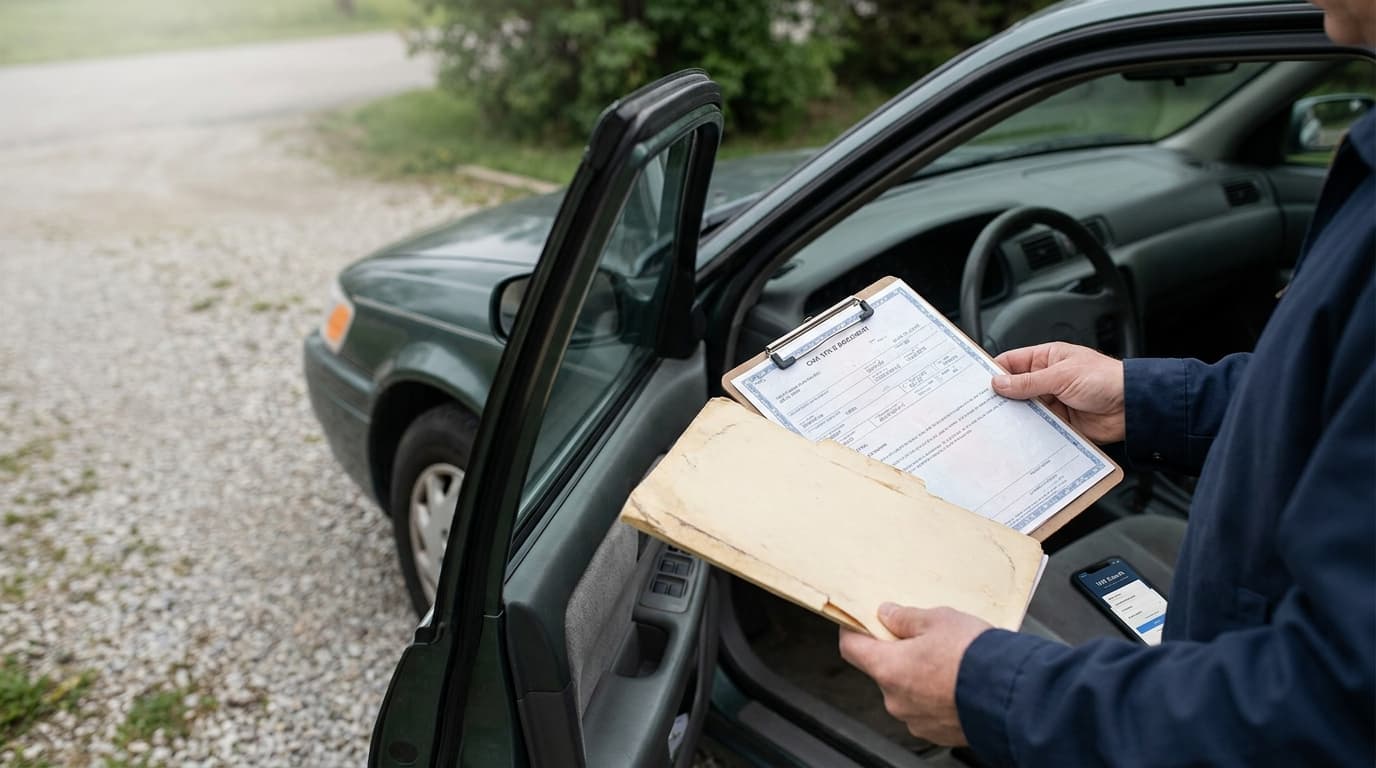
How to Check if a Car Has a Lien Before You Buy
A step-by-step guide on how to check if a car has a lien: read the title, run a lien check by VIN, pull DMV records, and call the lender for a payoff.
Oct 2, 20269 min read

Best Vehicle History Report Site: $16.99, No Subscription
Picking the best vehicle history report site? Compare one-time $16.99 pricing against monthly subscription plans and $44.99 single reports, side by side.
Sep 3, 20267 min read
How to Get a Cheaper Carfax Report (From $7.99)
A Carfax report bought on Carfax's own site has run about $45. Here is where to get the same report for $7.99, the free Carfax VIN lookup to run first, and the cheap-report scams to skip.
Oct 10, 20267 min read