How to Spot Odometer Rollback: A 9-Step Check
 Chris HansVehicle History ExpertAugust 31, 20269 min read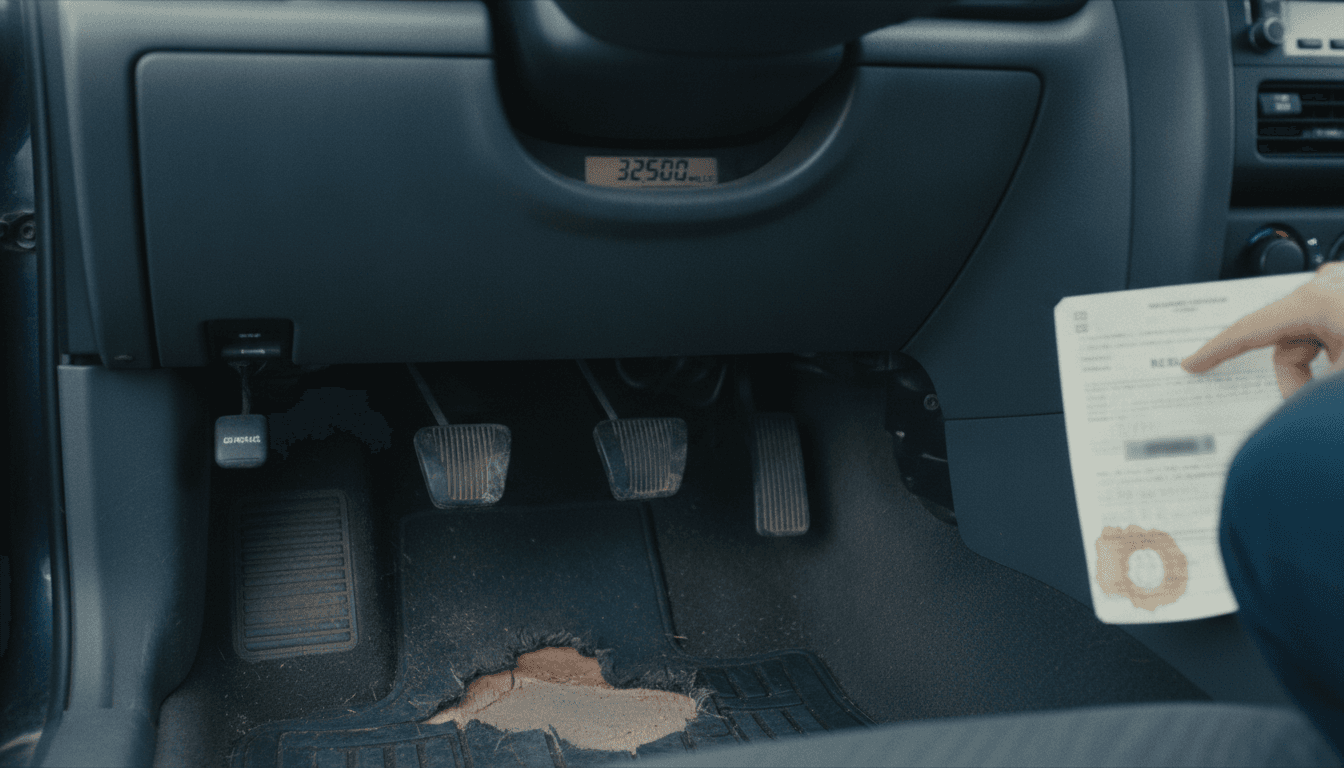
On this page
- At a glance
- What you need before you start
- How to spot odometer rollback, step by step
- Step 1: Write down the dash reading and the ad reading
- Step 2: Run the VIN and open the odometer chronology
- Step 3: Check the title brand section for mileage language
- Step 4: Compare the sales and usage timeline to the mileage curve
- Step 5: Look for auction photos with visible odometers
- Step 6: Inspect the wear points in person
- Step 7: Hunt for physical evidence around the cluster
- Step 8: Pull mileage from the car's other modules
- Step 9: Ask the seller three direct questions and watch the answers
- Reading an odometer discrepancy on title records
- Digital odometer fraud detection
- Troubleshooting
- The report has only two or three mileage readings
- Mileage goes down by a few hundred miles
- The seller says the cluster was replaced
- Dash and title match, but the car feels tired
- You already bought it
- What to do if you find fraud
- FAQ
- Can you tell if an odometer has been rolled back just by looking?
- How do I check car mileage history for free?
- Is a "not actual mileage" title always fraud?
- How much value does a rollback add for the seller?
- Do newer cars store mileage somewhere the cluster can't reach?
- What does TrulyCar's report show about mileage?
If you want to know how to spot odometer rollback, the short answer is that you compare the number on the dash against every recorded mileage reading in the car's paper trail, then check whether the physical wear on the car matches the story. A 2016 Accord showing 68,000 miles with a shiny worn-through brake pedal pad and a 2021 inspection record at 121,400 miles isn't a mystery. It's a rolled-back odometer.
NHTSA has estimated that more than 450,000 vehicles are sold each year in the US with false odometer readings, costing buyers over $1 billion. The fix isn't complicated, but it does take about 20 minutes of deliberate work before you hand over money.
- At a glance
- What you need before you start
- How to spot odometer rollback, step by step
- Reading an odometer discrepancy on title records
- Digital odometer fraud detection
- Troubleshooting
- What to do if you find fraud
- FAQ
At a glance
| Signal | What it looks like | How serious |
|---|---|---|
| Mileage goes backward between records | Aug 2022: 96,300 mi. Mar 2024: 71,880 mi. | Near proof of rollback |
| Suspiciously flat mileage | 4,000 miles added over three years on a commuter car | High: often a disconnected sensor or a swapped cluster |
| Title brand "NOT ACTUAL MILEAGE" or "EXCEEDS MECHANICAL LIMITS" | Printed on the title face or in NMVTIS data | High: the number on the dash is legally meaningless |
| Wear doesn't match miles | Sagging driver seat bolster, polished steering wheel at 60k | Medium: worth a records deep-dive |
| Missing service stickers or scrubbed history | No oil-change sticker, no dealer records, cluster fuses loose | Medium |
| Gap between odometer and inspection or emissions readings | State test at 118k, dash at 94k | High |
What you need before you start
- The 17-character VIN. Get it from the driver-side dash plate, the door jamb sticker, and the title. All three should match. If you only have the plate, a license plate lookup gets you there.
- A phone with a flashlight and a camera.
- A vehicle history report that includes an odometer chronology. TrulyCar's Complete Vehicle History Report is $16.99 and pulls title, brand, and mileage records from official government and industry sources including NMVTIS, plus NHTSA recall and spec data. You can start with the free VIN decode to confirm you have the right car.
- Photos of the title, front and back, if the seller will share them.
- An OBD-II scanner that reads stored mileage, or access to a shop that has one. A $30 Bluetooth dongle plus a paid app works on many 2008-and-newer vehicles.
Budget 20 to 30 minutes. Do the records first, in your driveway, before you drive across town.
How to spot odometer rollback, step by step
Step 1: Write down the dash reading and the ad reading
Photograph the instrument cluster with the ignition on. Note the exact number, including whether it's miles or kilometers (Canadian imports get converted, and a sloppy conversion is its own kind of discrepancy: 160,000 km is 99,419 miles, not 160,000). Compare it to the listing. Sellers who "round down" 8,000 miles in the ad are telling you something.
Step 2: Run the VIN and open the odometer chronology
In your TrulyCar report, scroll to the section listing dated mileage readings. Each row shows a date, a reported mileage, and the source type (title transfer, state inspection, auction listing, service entry). Read it top to bottom and look for two things: a number that goes down, and a stretch where the number barely moves.
Rollback detection flags the obvious reversals automatically. The flat stretches are on you to judge. Average US annual mileage runs roughly 12,000 to 14,000. A 2018 Camry with 41,000 miles in 2025 is possible but unusual, and worth asking about.
Step 3: Check the title brand section for mileage language
Look for the phrases "NOT ACTUAL MILEAGE," "NOT ACTUAL," "EXCEEDS MECHANICAL LIMITS," or "ODOMETER DISCREPANCY." Any of these means a DMV somewhere already concluded the reading couldn't be trusted. That brand should follow the car forever, but brands do get lost when a car crosses state lines, which is how title washing works.
Step 4: Compare the sales and usage timeline to the mileage curve
A car that was a rental in Florida for 26 months and then sold at 31,000 miles has a math problem. Fleet and rental vehicles typically pile on 25,000 to 40,000 miles a year. Same story for a car with a commercial or taxi entry in the usage timeline. Line the ownership dates up against the mileage readings and see whether the pace makes sense for how the car was used.
Step 5: Look for auction photos with visible odometers
Salvage and dealer auction listings often include a dashboard photo. If your report includes damage events with archived auction images, zoom in. A 2019 Silverado photographed at a 2023 auction showing 148,000 miles, now listed at 96,000, ends the conversation. This is also where you'd catch a car that took a serious hit and came back with a rebuilt title.
Step 6: Inspect the wear points in person
Parts that wear on a predictable schedule:
- Brake pedal pad and gas pedal. Rubber worn smooth or through means 100,000-plus in most cars.
- Steering wheel. Shiny at 10 and 2, or leather cracked at the stitching.
- Driver seat. Collapsed left bolster, sagging foam, a seat-back that no longer holds position.
- Driver door armrest and window switch. Lettering rubbed off the window switch is a high-mileage tell.
- Original tires. Check the DOT date code. If a 2020 car still wears its factory tires with decent tread and the dash says 89,000 miles, the numbers fight each other.
- Sun visor, headliner near the door, and the carpet under the driver's heel.
Step 7: Hunt for physical evidence around the cluster
Analog odometers used to show misaligned digits or gaps between number wheels. Digital clusters hide better, but the removal doesn't. Look for scratched or missing screws on the cluster bezel, trim clips that don't sit flush, scuffs in the dash plastic, and fingerprints or dust smears on the inside of the gauge lens. Check whether the cluster's part number sticker matches the car's build year if you can see it.
Step 8: Pull mileage from the car's other modules
This is the part most buyers skip and it's the strongest single check on a modern car. Details vary by brand, so use whichever of these applies:
- Oil life or service reminder menu. Many GM, Ford, and Toyota systems store the mileage at the last service reset.
- Stored fault codes with mileage stamps. Most 2010-and-newer vehicles record the odometer value when a code sets. A code stored at 132,000 miles on a car showing 88,000 is your answer.
- Dealer service history. A franchise dealer can look up the VIN in the manufacturer's system and read out recorded service mileage. Call the parts or service desk and ask for a "VIN service history print." Many will do it free.
- Key fob memory. Some BMW and Mercedes keys store mileage that a dealer tool can read.
Step 9: Ask the seller three direct questions and watch the answers
Ask when the last oil change was and at what mileage. Ask whether the instrument cluster has ever been replaced. Ask for the title photo. A private seller with a clean car answers all three in under a minute. Hedging, a story about a "faulty gauge," or a title that suddenly isn't available yet tells you to walk.
Reading an odometer discrepancy on title records
Federal law requires a written odometer disclosure at nearly every transfer of ownership. When a seller reports a number lower than what the state already has on file, the DMV can brand the title. That's what an odometer discrepancy on title means in practice: the state recorded a conflict.
Not every discrepancy is fraud. Real causes include:
- Clerical typos. 87,412 keyed as 8,741 or 187,412. A single-digit slip usually shows as one weird row surrounded by consistent ones.
- Replaced clusters. A failed cluster gets swapped with a used unit and the new reading is whatever the donor had. This is legal only when properly disclosed with a sticker on the door jamb stating the pre-replacement mileage and date.
- Five-digit odometers rolling over. Cars from the 1980s and earlier top out at 99,999 and restart. That's the origin of "exceeds mechanical limits."
- Kilometer-to-mile conversion errors on imports.
The problem is that all four excuses are also the exact stories a fraudster tells. Treat any branded title as "mileage unknown" and price the car as if it has the highest mileage in its records, not the lowest.
Digital odometer fraud detection
Rollback used to mean a drill and a cable. Now it means a laptop. Programming tools sold openly online will rewrite the stored mileage in an instrument cluster in a few minutes, and on many vehicles built before roughly 2015 that single write is enough to make the car look consistent.
Newer vehicles are harder to fake because mileage gets mirrored across modules: the engine control unit, the transmission controller, the body control module, the ABS unit, and sometimes the airbag module all keep their own copy. Sloppy work updates the cluster and leaves the rest untouched. That mismatch is the backbone of digital odometer fraud detection, and it's why a scan tool that reads module-level data is worth more than a walkaround.
Three signs of a digital job:
- The cluster reads a round number with no service or fuel-trim data behind it that agrees.
- Stored codes or freeze-frame data carry mileage stamps higher than the dash.
- The dealer's manufacturer records show service events at mileages the car has supposedly not reached.
If you're serious about a car and it's over 60,000 miles or costs more than $12,000, pay a shop $120 to $180 for a pre-purchase inspection and specifically ask them to compare module mileage. It's the cheapest insurance in the process.
Troubleshooting
The report has only two or three mileage readings
Common for cars that lived in states with no periodic inspection requirement, or that were serviced only at independent shops that don't report. Thin records aren't evidence of fraud, but they do shift the burden to physical inspection and a dealer service lookup. Ask the seller for receipts. Oil-change shops keep records by phone number, and a seller who bought their oil changes at the same chain can usually pull a printout.
Mileage goes down by a few hundred miles
Almost always a reporting artifact: two records entered the same week, one estimated. A drop of 200 miles is noise. A drop of 20,000 is not.
The seller says the cluster was replaced
Ask for the repair invoice with the date and the mileage at replacement, and check the door jamb for the required disclosure sticker. Federal rules say the sticker has to be there. No paper and no sticker means you're guessing, and you should price accordingly.
Dash and title match, but the car feels tired
Trust the car. Worn suspension bushings, a slipping torque converter, and a rough idle on a "55,000-mile" 2017 sedan mean either hard use or a rewritten number. Get the module scan.
You already bought it
You still have options. Keep every document, get a written shop assessment of the actual condition, and file a complaint with your state attorney general and with NHTSA. Odometer tampering is a federal crime under 49 U.S.C. Chapter 327, and civil remedies can include treble damages or $10,000, whichever is greater, plus attorney's fees. Talk to a consumer attorney before the statute of limitations runs.
What to do if you find fraud
Walk away first. Then report it. You can file with NHTSA at nhtsa.gov and with your state DMV's investigations unit. Save the listing screenshot, the VIN, the seller's contact info, and your report PDF. Dealers who roll odometers do it repeatedly, and complaints with documentation are what shut them down.
If you're checking several cars, running a report on each one is normal practice. Big-name single reports tend to sit around the $45 mark, which gets expensive fast when you're screening four candidates. TrulyCar's 3-pack is $29.99 and the 5-pack is $44.99, with no subscription to cancel. More on how the coverage compares in our TrulyCar vs CARFAX breakdown.
FAQ
Can you tell if an odometer has been rolled back just by looking?
Sometimes, if the fraud was lazy. Worn pedals, a polished steering wheel, and a collapsed driver's seat on a low-mileage car are strong hints. But a careful rollback on a clean, detailed car passes a visual check, which is why records and a module scan matter more than eyeballing.
How do I check car mileage history for free?
NHTSA's VIN decoder gives you specs and recalls, not mileage. Some states let you pull your own vehicle's inspection history online. A franchise dealer will often print the manufacturer's service history for a VIN at no charge. For a dated chronology of readings pulled from title and inspection records, you need a paid report.
Is a "not actual mileage" title always fraud?
No. Cluster replacements, five-digit rollovers on older cars, and DMV typos all produce that brand legitimately. The brand means the reading isn't verified, so value the car on condition and on the highest recorded mileage you can find rather than on the dash.
How much value does a rollback add for the seller?
That's the whole motive. Knocking 40,000 miles off a mid-size sedan can move its retail value $2,500 to $4,500, and on a three-quarter-ton diesel truck the swing can top $8,000. A $200 programming tool pays for itself on one car.
Do newer cars store mileage somewhere the cluster can't reach?
Yes, on most vehicles from roughly the mid-2010s forward. Engine, transmission, ABS, and body control modules keep their own mileage values, and fault codes are stamped with the odometer reading at the time they set. A scan tool that reads live and stored module data will usually expose a mismatch.
What does TrulyCar's report show about mileage?
An odometer chronology with dated readings and rollback flags, plus title and brand checks that include mileage-related brands, damage events with archived auction photos where available, the sales and usage timeline, open recalls, factory maintenance schedule and warranty terms, and market values by condition. One report is $16.99.
Chris Hans
Vehicle History Expert
Chris Hans writes TrulyCar's practical guides for used-car buyers, built on the same NMVTIS title data and NHTSA records that power our reports.
Buying a used car? Check its history first.
Run a free VIN checkKeep reading
How to Spot Odometer Rollback Before You Buy
Learn how to spot odometer rollback with a records-first check: title brands, mileage chronology, wear clues, and what to do when the numbers don't line up.
Sep 8, 20269 min read
Title Washing Explained: How Salvage Cars Go Clean
Title washing turns a salvage car into a clean-titled one on paper. Here's a 9-step check to catch a washed title before you hand over money.
Sep 4, 20269 min read
How to Spot a Flood Damaged Car From Out of State
Learn how to spot a flood damaged car shipped across state lines: title brands, NMVTIS flood checks, auction photos, and the 9 physical signs sellers miss.
Sep 3, 20268 min read